Cerakote vs. Powder Coating: What Is the Difference?
Coating your components is a vital process that can protect them from various types of damage while improving their appearance. However, it is not always clear what the best type of coating for your parts may be.
Two common coating processes are Cerakote and powder coating. Each has its pros and cons, but it is important to choose the right process for your needs. Otherwise, you may ruin your part, increase your costs unnecessarily, or achieve substandard results.
What Is Powder Coating and How Does It Work?
Powder coating is a process that applies a powder made of polymer resin, leveling agents, pigments, and other ingredients to metal in order to protect and finish its surfaces.
First, the powder is applied to the surface. Then, it is electrically charged until it fuses with the metal. The powder is cured with heat until it hardens onto the metal surface. Introduced in the U.S. in the 1960s, it has become a popular method of metal finishing.
What Is Cerakote and What Is It Used For?
Cerakote is a polymer-ceramic coating that is sprayed onto metal surfaces to create a thin yet tough film. Designed to be highly resistant to several types of damage, it can also be applied to other materials, such as wood and plastic, making it a versatile solution.
What Are the Similarities Between Powder Coating and Cerakote?
Before you look at the differences between Cerakote and powder coating, it is important to look at how they are similar. This will give you an understanding of why you may want to consider either one. Their main similarities are:
- Purpose: Powder coating and Cerakote can both be applied to a part to protect it.
- Customization: Both processes allow you to customize the part’s appearance.
- Preparation: The part’s surface must be sufficiently prepared before either product type can be applied.
- Environmental impact: Cerakote and powder coating are both considered environmentally friendly products.
What Is the Difference Between Powder Coating and Cerakote?
While they both create a finish that protects a part’s surface, there are many differences between powder coating and Cerakote.
Durability and Hardness
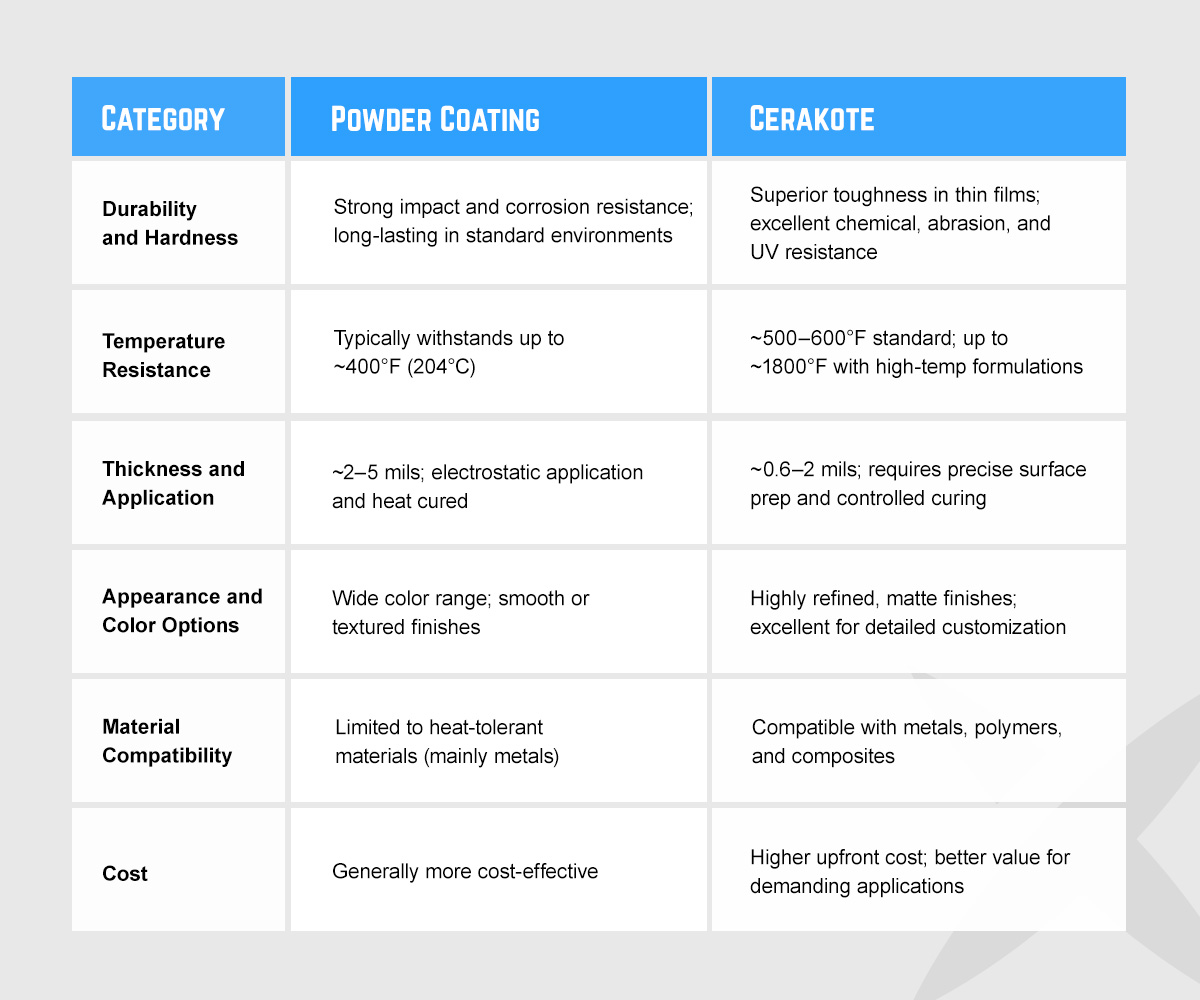
While powder coating protects against impact damage and corrosion, Cerakote is a highly resistant solution, often excelling in toughness and durability in thin film applications. Cerakote is also more resistant to chemicals and UV radiation, making it a strong contender for protecting a metal surface from damage.
Both Cerakote and powder coating can last a long time, though the duration will depend on how the item is used and the level of exposure it faces. Typically, powder coating will last from 15 to 20 years, but it can last as long as 40 years in certain conditions. It is harder to say exactly how long Cerakote can last, as it is often used in harsh conditions. However, due to its specific properties, Cerakote often provides superior performance in conditions where abrasion, chemical resistance, or thinness are critical.
Temperature Resistance
Powder coatings can vary in how much temperature they can withstand. While there are some powders that are specifically designed to withstand higher temperatures, standard powder coatings can usually provide protection up to 400°F (204°C).
Cerakote is able to provide protection at much higher temperatures. While general-purpose Cerakote typically withstands temperatures up to 500-600°F (260-315°C), specific high-temperature Cerakote formulations can maintain structural integrity up to 1800°F (982°C). The exact Cerakote used will affect the maximum temperatures it can withstand.
Thickness and Application
Both powder coating and Cerakote can be applied in ultra-thin layers. Cerakote is typically thinner. A standard Cerakote coat is usually 1-2 mil thick, but some coats can be as thin as 0.6 mil. Powder coating is typically 2-5 mil thick. This difference in thickness means powder coating typically adds more weight to the component than Cerakote does.
The application method differs between Cerakote and powder coating, too. The Cerakote application process is more complicated and requires the component’s surface to be carefully prepared. The Cerakote is then applied using professional equipment, after which it needs to be either air or oven cured at a specific temperature, which requires precise temperature control technology. For this process to succeed, it must be carried out by skilled technicians.
Applying powder coating requires thorough surface preparation, often involving multiple stages of cleaning and pre-treatment for optimal adhesion and performance. Once the component is ready, the powder coating is applied as an electrostatic powder, heat-cured, and then allowed to cool. This application method is simpler. Standard powder coating typically achieves the desired thickness in a single coat, though specialized finishes or specific performance requirements may call for multiple layers.
Appearance and Color Options
Both powder coating and Cerakote offer various colors and finishing options. However, Cerakote creates a more refined finish, which is why it is preferred for premium products. Cerakote is also much easier to customize during its application process. It is often used when careful detailing is required.
Material Compatibility
Thanks to its higher curing temperatures, powder coating can only be applied to materials that can withstand these temperatures. Usually, these materials are metal.
Cerakote can be applied to a wider variety of materials since its curing temperature is lower, making it more widely applicable.
Cost
Depending on your financial goals, Cerakote or powder coating could be the best solution for you. Cerakote requires a higher initial investment thanks to the specialized equipment and training costs. Powder coating can also be more expensive than some options, though typically not as much as Cerakote.
In the long run, Cerakote may provide better value in applications where its specific durability advantages significantly extend part life. The speed and cost-effectiveness of each process can vary greatly depending on the application, part volume, and setup. Powder coating, with its reclaim capabilities, often demonstrates high efficiency in material usage.
Which Is Better for Your Project: Cerakote or Powder Coating?
Both Cerakote and powder coating are effective ways to protect and finish metals. Each offers distinct advantages, and the choice between them ultimately depends on the specific requirements of the application. While Cerakote provides exceptional performance in aspects like thinness, chemical resistance, and certain high-temperature scenarios, powder coating remains an excellent and often more economical choice for many general industrial and decorative applications.
How can 10X Engineered Materials Help You Achieve Ideal Surface Preparation?
Whichever option you choose, the first step toward a perfect powder coating or Cerakote finish is excellent surface preparation.
At 10X Engineered Materials, our strong and efficient superoxalloy abrasives are ideal for surface preparation. Sandblasting with biosoluble superoxalloy, such as EpiX, creates a clean surface ready for finishing. With virtually no particles embedded in the surface, you can set the foundation for an excellent finish. Our abrasives can also be reused many times.
To find out more about how our abrasives can prepare your surfaces for Cerakote or powder coating, contact us today.