
How Does Surface Preparation Impact Coating Adhesion?
Effective surface preparation for coating adhesion is perhaps the most important factor in whether the coating successfully sticks to the material’s surface. Even if the coating does succeed, the preparation will affect the durability and performance of the coating, not to mention whether the surface meets the relevant industry standards.
Surface preparation can either be carried out through mechanical or chemical means, but choosing the right method is key to achieving the highest-quality coating adhesion.
This guide by 10X Engineered Materials explains what surface preparation is, why it’s so important, and what the various surface preparation methods are.
Key Takeaways
- Surface preparation helps the coating to stick to the surface and improves the coating’s performance.
- The two key adhesion mechanisms are chemical and mechanical.
- Inadequate preparation can cause blistering, delamination, and corrosion undercutting.
- Cleanliness describes the level of contamination of the surface, while surface profile describes the surface roughness.
- Abrasive blasting is one of the most popular and effective methods of surface preparation.
- Industry standards inform manufacturers and buyers about the surface profile and cleanliness.
Why Surface Preparation Is Vital
The importance of surface preparation can’t be overstated, as it’s the key to coating adhesion in several key ways.
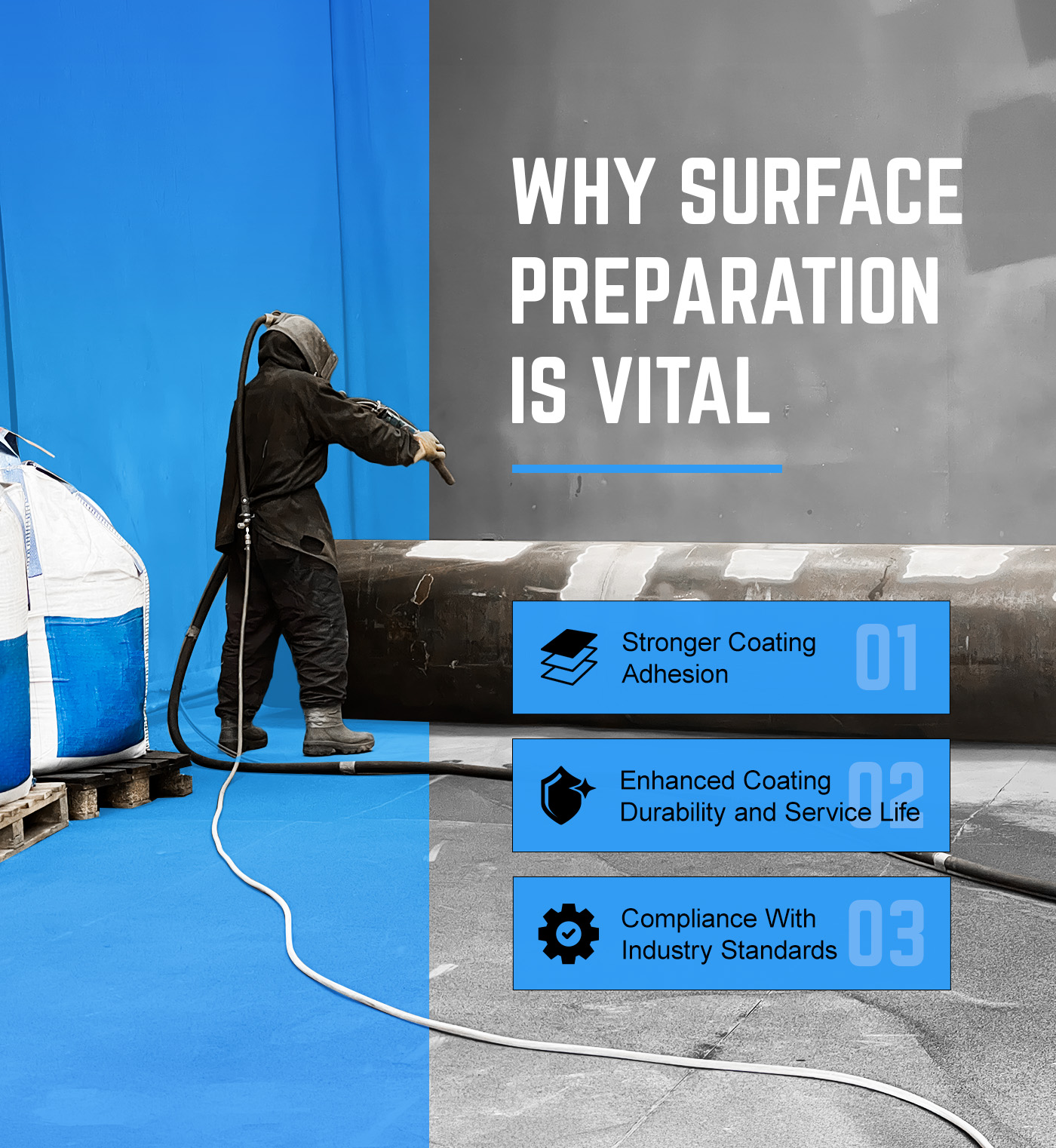
Stronger Coating Adhesion
A surface that has been prepared effectively can produce stronger mechanical adhesion. This type of adhesion occurs when the coating flows into the microscopic peaks and valleys known as the anchor profile, which is created by abrasive blasting. Here, the coating locks in place as it cures, with the peaks and valleys providing thousands of anchor points over every square inch.
Chemical adhesion provides additional strength. This adhesion type requires a clean and reactive substrate free of any contaminants that could prevent molecular-level bonding between the metal and the coating.
A surface that hasn’t been prepared may not have the anchor profile needed for mechanical adhesion, while also retaining contaminants that prevent effective chemical adhesion.
Enhanced Coating Durability and Service Life
Even when the coat sticks to the surface, ineffective surface preparation can result in reduced longevity and performance standards. A coating that you apply to a thoroughly prepared surface can better resist blistering, delamination, and corrosion undercutting than a coat applied to an unprepared or compromised surface can.
Even if the surface appears to be suitable for coating, invisible contaminants or profile deficiencies may still exist on the surface, which can become failure points over the lifetime of the coating. These failure points allow temperature cycling, mechanical stress, and moisture to expose weak adhesion bonds.
That’s why it’s vital to properly clean and profile a surface for the best chances of a continuous and pinhole-free coating.
Compliance With Industry Standards
While surface preparation can deliver improved performance in the coat you apply, the benefits of this are often more than additional selling points. In many industrial settings, surface preparation is a codified requirement. These codes help ensure that anyone purchasing or using materials with a coat applied can expect a certain standard of quality and performance.
Whether it’s the SSPC/AMPP cleanliness standards or the ISO 8501-1 framework, these standards will likely specify the quality of the surface preparation and detail verification methods. These standards may not be legally required, but they’re often required by businesses in many industries, such as:
- Marine
- Military
- Infrastructure
- Industrial manufacturing
Failure to meet the relevant surface preparation standards could exclude your products from certain buyers, void warranties, and lead to failed inspections.
How Surface Preparation Affects Coating Adhesion
When a coating fails, the first place to look for the cause is often the surface preparation method and execution.
Contamination Prevents Coating Bonds
There are several types of contaminants that can prevent coatings from bonding onto the material surface, including:
- Oils and grease: Whether they’re picked up in an industrial setting or transferred from a worker’s hands, surfaces are often contaminated with oil and grease. These contaminants can lower surface energy and prevent the coating from wetting and bonding to the substrate.
- Rust and corrosion: Sitting on top of sound metal, rust and corrosion act as a barrier between this metal and the coating, preventing the two from bonding.
- Mill scale: This iron oxide layer forms on steel during hot rolling and causes corrosion and delamination under the coat.
- Soluble salts and chlorides: A common cause of blistering, soluble salts and chlorides create osmotic cells beneath the coating.
Profile Deficiencies Cause Coating Failure
Profile deficiencies can come in two forms, both of which can cause failures in the coating.
First, a surface with a profile that’s too shallow or nonexistent won’t provide sufficient anchor points for the coating to flow into. This results in a weak adhesion that could cause peeling or delamination when placed under stress.
However, a surface that has overly deep anchor points can cause problems, too. Deep anchor points lead to tall peaks, which can protrude through the thin films of coating and produce pinpoint corrosion sites when the profile isn’t covered by a sufficient thickness of coating. For the overly-tall peaks to be sufficiently covered by the coating, more coating is needed to cover the surface. This leads to a higher consumption of coating without providing any additional benefits.
Surface Preparation Methods for Coating Adhesion
Surface preparation is key, but the method you use can affect how effective your preparation is. Choosing the method that’s best suited to the substrate, coating system, and field conditions can affect the cleanliness and surface profile of the material.

Abrasive Blasting
Abrasive blasting is one of the most popular surface preparation methods that reliably delivers a high level of cleanliness and an anchor profile. This method works by propelling abrasive particles at high velocity against the surface, which removes contaminants, corrosion, mill scale, and existing coatings. At the same time, an anchor profile is etched into the substrate.
Like any surface preparation method, abrasive blasting doesn’t guarantee a flawless surface for coating. Factors that can affect how successful the surface preparation is include:
- Abrasive type
- Particle size and shape
- Blasting pressure
- Nozzle standoff distance
- Angle
The choice of whether to use dry or wet abrasive blasting can affect your results, too. Dry abrasive blasting only uses dry abrasive media, while the wet variant of this method introduces water into the abrasive mixture.
Abrasive blasting is the standard method for preparing steel because it removes mill scale and creates a uniform surface profile in a single step.
Power Tool Cleaning
Whether it’s because you’re working in a confined space or area where dust control is critical, or you’re carrying out localized repairs, abrasive blasting isn’t always a suitable surface preparation method. In these situations, power tool cleaning can offer a reliable alternative, which is why it’s regularly used for maintenance or repairs.
You can achieve a high degree of cleanliness using tools such as grinders, needle guns, and rotary wire brushes. However, this method doesn’t achieve an anchor profile that’s as consistent as you’d get through abrasive blasting. Instead, power tool cleaning tends to create a nonuniform anchor profile, which may mean coating adhesion isn’t as effective.
Solvent Cleaning
Solvent cleaning is a chemical surface preparation method that works well alongside a mechanical method. Using chemicals that typically include solvents, degreasers, or detergents, solvent cleaning can remove oils, greases, and other organic contaminants from a surface. However, since this method can’t create an anchor profile or remove rust or mill scale, using this method alone would result in a surface that isn’t sufficiently prepared for coating.
It’s usually best to apply solvent cleaning before mechanical preparation. If mechanical methods like abrasive blasting are applied first, contaminants that should have been removed by solvent cleaning can be driven into the anchor profile.
Water Jetting
Water jetting prepares surfaces in a similar way to abrasive blasting, except it doesn’t use any dry abrasive media. Instead, it blasts pressurized water at the surface to remove coatings, corrosion, and soluble salts. However, unlike abrasive blasting, water jetting doesn’t create an anchor profile; it simply cleans the existing profile or removes any coating in the profile. That’s why this method is best suited to surfaces that already have an anchor profile.
The pressure used in water jetting can be adjusted depending on your goals. Ultra-high pressure is best when you need to remove intact coatings, while a lower pressure usually suffices for general cleaning.
It’s important to note that flash rust control is required after water jetting on steel.
Surface Preparation Standards for Coating Applications
Surface preparation shouldn’t be something you guess at. It’s a process that’s commonly specified, measured, and verified against established industry standards. Customers want to be sure that the products they purchase meet the required standards, which is why coating manufacturers should provide cleanliness and profile grades in their product data sheets.
To reliably deliver the necessary standards on every product, manufacturers must know what the various standards are, how to achieve them, and how to accurately verify and document them.
Cleanliness Grades and What They Mean
The SSPC/AMPP cleanliness standards are widely used as the primary framework for surface preparation cleanliness before coating across the United States.
The standards that define the surface’s cleanliness and characteristics include:
-
SSPC-SP 1: Surfaces that meet SP-1 standards have been cleaned with solvents to remove oil, dirt, grease, and other soluble contaminants.
-
SSPC-SP 2: Hand tool cleaning to remove loose mill scale, loose rust, and loose paint. Tightly adhering material can remain.
-
SSPC-SP 3: Power tool cleaning to remove loose mill scale, loose rust, and loose paint. Like SP-2, it does not require removal of tightly adhering material.
-
SSPC-SP 5/NACE No. 1: A joint SSPC/NACE standard, it describes a steel surface that’s been cleaned to a white metal condition through abrasive blasting. This means the material doesn’t show any contamination to the naked eye. This standard is required for immersion services and the most demanding applications, and is similar to the ISO 8501-1 Sa 3 standard.
-
SSPC-SP 6/NACE No. 3: Also detailing steel surface cleaning through abrasive blasting, this standard requires that no dust, oil, grease, rust, mill scale, coating, or oxides are visible without magnification. However, staining from old contaminant exposure is acceptable, provided the staining doesn’t cover more than 33% of each area unit. SP-6 is roughly equivalent to the ISO 8501-1 Sa 2 standard.
-
SSPC-SP 10/NACE No. 2: This standard is similar to SP-6, except that just 5% of each unit area can show staining from contamination. This standard is commonly specified for high-performance industrial coating systems, and is similar to the ISO 8501-1 Sa 2½ standard.
-
SSPC-SP 11: Describing the requirements for taking a surface to bare metal using power tools, this standard also requires that a surface profile of at least 1 mil is achieved. SP-11 is applied in situations where abrasive blasting is impossible or unfeasible. Unlike SP-3, which removes only loose material, SP-11 requires removing all visible rust, mill scale, and coating.
Surface Profile Specifications
Measured separately from cleanliness, surface profile, also known as surface roughness and anchor profile, is specified in either mils or micrometers. Coating manufacturers typically specify an acceptable profile range in their product data sheets, which is usually expressed as a minimum and maximum.
ASTM D4417 is the standard field test method for measuring surface profile. It describes three methods: a visual comparator (Method A), a depth micrometer (Method B), and replica tape (Method C). The depth micrometer and replica tape are the most common in practice.
Data sheets also specify a recommended dry film thickness (DFT), and the relationship between profile height and DFT matters. While there’s no single overarching standard for this relationship, a general rule of thumb is that the DFT should be at least three to four times the average surface profile height.
Prepare Your Surface for a Successful Coating
From enhanced durability to the increased chances of the coating sticking to the surface, successful and effective surface preparation can improve your products’ performance and appearance. It can also help you meet the relevant standards and build trust with your customers.
However, choosing the right surface preparation methods is vital to achieving the required standards. Whether it’s abrasive blasting, solvent cleaning, power tool cleaning, or water jetting, consider the substrate, coating system, and field conditions that you’re working with. What’s more, you also need to know exactly which standards your surface must meet.